Research
Water-cycle processes, from the root zone to the river basin.
Climate & resilience
Hydroclimatic extremes
We investigate the response of watersheds and vegetation to compound heat-drought events. By connecting water-balance modeling with environmental observations, we identify vulnerable regions and examine the effects of extremes on root-zone water storage and heat risk.
- Compound heat and drought
- Root-zone water storage
- Ecosystem vulnerability
Water & ecosystems
Ecohydrological modeling
Our research links infiltration and runoff processes with evapotranspiration, vegetation water use, and biogeochemical dynamics. Work spans layered soils, Mediterranean-climate forests, and mountain catchments, combining process-based models with field observations.
- Evapotranspiration
- Soil infiltration
- Water-carbon interactions
Sensing & observations
Multi-source data fusion
We integrate remote sensing and ground-based measurements to estimate precipitation, map snow water equivalent, and detect the rain-snow transition. Wireless sensor networks and IoT-based soil monitoring connect local measurements to catchment-scale understanding.
- Wireless sensor networks
- Snow water equivalent
- Remote sensing & IoT
AI & environmental science
AI for water prediction
We explore deep learning, time-series foundation models, and data assimilation for hydrological and water-quality prediction. Applications include nitrogen forecasting under data scarcity and snowpack estimation supported by ground observations.
- Time-series foundation models
- Water-quality forecasting
- Deep learning
Science & decisions
Water resources management
We study river-lake connectivity, human-water relationships, and the capacity of regional water resources to support development. This work connects hydrological processes with environmental management and the effects of human activities.
- River-lake connectivity
- Human-water relationships
- Regional carrying capacity
Process-based modeling
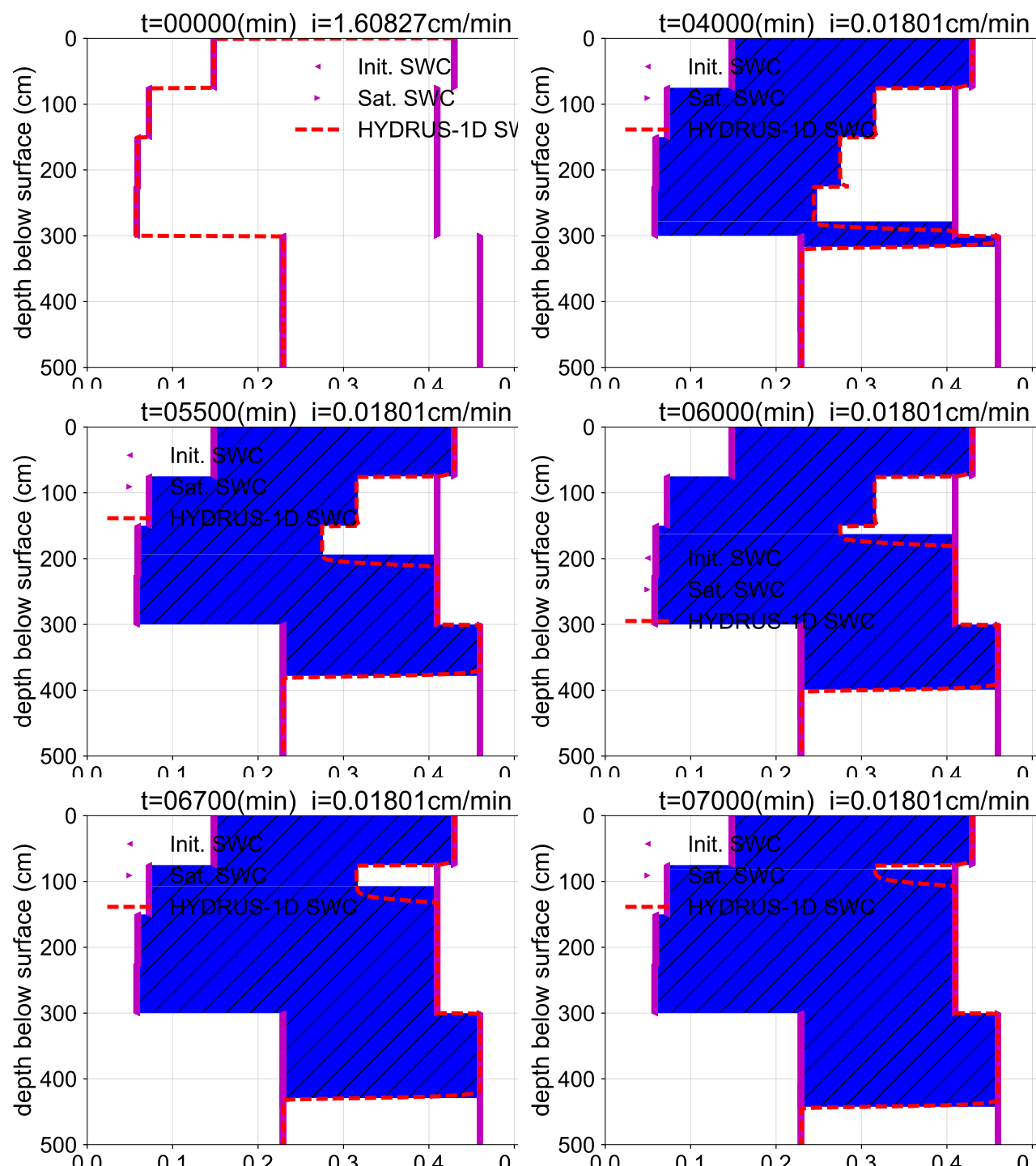
Infiltration in layered soils.
Physically based models help explain how soil structure and slope influence the movement of water below the surface.